Don’t Be Afraid
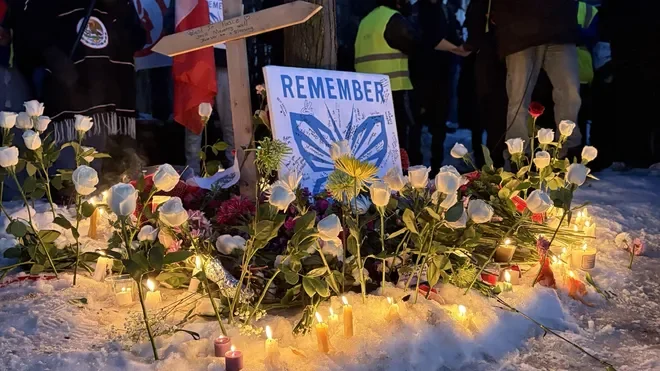
Last night I walked with my pastor from our church to the vigil being held for Renee Good. On the way we talked about the Lord’s Prayer.
We talked about what it means to ask for God’s kingdom to come, the extensive changes needed for that reality to manifest. We talked about the phrase, “forgive us as we forgive others.” In the Lord’s Prayer, we don’t ask God to forgive us perfectly, as only God is capable of. We are instead saying to God, “Treat me as I treat others.” That’s a bit frightening to think about. If our hearts are filled with hate and ignorance and fear, then we are quite literally asking God to hate us. This prayer, perhaps the most frequent prayer of Christians, is about accountability and honesty. It is about justice. How do we treat others? God is merciful: are we?
We talked about the day my Greek class translated the prayer together, the emphasis on the first person plural. The prayer is for we, us. The first word of the prayer is “our.” We do not pray for “my daily bread,” but “our daily bread.” God directs us to pray collectively, on behalf of others. Community has always been part of God’s vision for us.
My friend, the poet and activist, Chavonn Williams Shen, has written some wonderful devotionals for the Our Bible app. (Chavonn Williams Shen’s recent work, Still Life with Rope and River, is available at MoonPalace Books in Minneapolis and online.) In Revelations of Blackness: Making the Truth Known, Shen explores Revelations 7:13-14. “Then the elders asked me, ‘These in white robes – who are they, and where did they come from?’ I answered, ‘Sir, you know.’”
“How many times have I asked someone what I already knew?” writes Shen. “But I think, in so many of those times, I do it because I need someone else to say it to confirm that it’s true, to confirm that it’s not just my own wishful thinking.”
When we arrived at the vigil, we were given candles and the community had gathered in a large circle to listen to the faith leaders and organizers speak. I was grateful for the circle, to see my oscillating confusion and sadness and determination reflected back to me in other faces. There is something calibrating, reassuring to the nervous system, to be together in disorienting times.
We have never needed community more. We need the calibration of shared reality. It is grounding to look our neighbors in the eye and confirm again and again what we already know: this is a tragedy. We believe our eyes and ears and hearts. George Floyd. Philando Castile. Fletcher Merkel. Harper Moyski. Melissa Hortman. Mark Hortman. Renee Good. These and countless more, they should be alive today. This is the truth. We know this. We ask questions we already know the answers to. We echo the truth to one another, confirming we are still human, still capable of heartbreak.
~
Yesterday I finished Bryan Stevenson’s Just Mercy, assigned in preparation for a Civil Rights Pilgrimage I’ll be joining in Georgia and Alabama later this month. Stevenson writes about his work as a lawyer trying to save people, often entirely innocent, from death row. He writes about the ways America’s criminal justice system is used to oppress all vulnerable groups, particularly people of color, but also children, women, people with mental illness, and the poor. Often he meets, too late, people who did not get a fair trial and are sent to their deaths without a chance for justice.
“It’s been so strange, Bryan,” says Herbert Richardson during their last conversation before Richardson, a Vietnam War veteran with PTSD, is executed for a crime committed with no intent to harm. “More people have asked me what they can do to help me in the last fourteen hours of my life than ever asked me in the years I was coming up.”
“You can’t effectively fight abusive power, poverty, inequality, illness, oppression, or injustice and not be broken by it,” writes Stevenson. “There is a strength, a power even, in understanding brokenness, because embracing our brokenness creates a need and desire for mercy, and perhaps a corresponding need to show mercy.”
One day while leaving the courthouse Stevenson meets a woman whose 16-year-old grandson had been murdered over a decade before. The boys responsible were sent to prison forever. This verdict hadn’t made her feel any better. It hadn’t felt like justice. She saw the cycle of suffering and the way it spread in the community, in the imprisoned, in family and friends of both sides of each case, hurt that went on and on, hurt that the justice system did not ease but rather perpetrated. So she stayed at the courthouse, and she was a shoulder for some of that pain and heaviness to fall on.
“All these young children being sent to prison forever, all this grief and violence,” she said. “Those judges throwing people away like they’re not even human, people shooting each other, hurting each other like they don’t care. I don’t know, it’s a lot of pain. I decided that I was supposed to be here to catch some of the stones people cast at each other.”
I believe in peace and love like this woman at the courthouse. I believe in being broken open by injustice and refusing to succumb or ignore or be destroyed by it. I believe in us, returning day after day, to this slow and steady work of healing, refusing to be lost to fear and ignorance, refusing to hate one another.
~
After the vigil, we walked back to the church. We stopped down in the basement. The servers had set aside meals for us. The little things become big things. A shared meal is perhaps the best metaphor for Christianity, sustaining together. Eating together this way makes me feel the nearness of God’s kingdom.
Then we gathered in the darkened sanctuary for the Epiphany service. Shortly after his birth, Jesus’ family was forced to flee as king Herod ordered the slaughter of children, a powerful tyrant oppressing the most vulnerable in order to maintain his crown. Today, we might call Jesus’ family “illegals.” We might watch them being dragged away by masked men in unmarked vehicles, Jesus being ripped from Mary’s arms and his family disappeared. We might claim they should have done something different if they didn’t want to be treated this way. We might be tempted to say anything that separates us from the abject cruelty of such treatment, something that reassures us it is somehow warranted and could never happen to us. We might say nothing at all.
Jesus was executed by his government. The life of our Lord and Savior begins and ends with state sanctioned violence. The story of Christianity cannot be told honestly without acknowledging this truth. When we point to the cross, we point also to the systems that necessitated just a sacrifice, to the forces of ignorance and injustice still at work today which would kill our Savior all over again.
So we told the story, even the hard parts we wish weren’t true, and during worship we wrote on stars our prayers for the vulnerable. For widows, orphans, refugees, for migrants, for protestors, for the sick, for the grieving, for the frightened, for our neighbors. We hung the stars on the altar where they deserve to shine. These are God’s people, and Christ lifts them up.
~
My heart is heavy today. I feel small and vulnerable and helpless in the face of these oppressive powers, in the face of fellow Christians who do not want the truth, in the face of greed and cruelty and hate and silence that perpetuates violence. But I opened my email and there were these things: a message from our pastors reminding us of the importance of dialog. A member asking where to donate oral health supplies to those in need. Organizers sharing safety protocol trainings. Plans to meet with a community partner to deepen our impact on youth homelessness.
Perhaps I am small, but I do not get to know the extent of my impact, and neither do you. So we will keep going in all these small, humane ways. We will not lose hope and we will not disengage. We will go together.
~
Bryan Stevenson met Rosa Parks on several occasions. He writes, in Just Mercy, about the time she asked what it was he did for work and he rattled off the extensive justice projects he was involved in.
“Ms. Parks leaned back smiling. 'Ooooh, honey, all that's going to make you tired, tired, tired.' We all laughed. I looked down, a little embarrassed. Then Ms. Carr leaned forward and put her finger in my face and talked to me just like my grandmother used to talk to me. She said, 'That's why you've got to be brave, brave, brave.'”
There’s a hymn we sang at the beginning of the semester and I’ve thought of it nearly every day since. “Don’t Be Afraid” from All Creation Sings. The lyrics could not be easier to recall and I use them like a worry stone, rolling them over in my head when I’m feeling short on courage.
Don’t be afraid, my love is stronger, my love is stronger than your fear.
Don’t be afraid.
My love is stronger, and I have promised, promised to be always near.