Name the Sin: White Supremacy
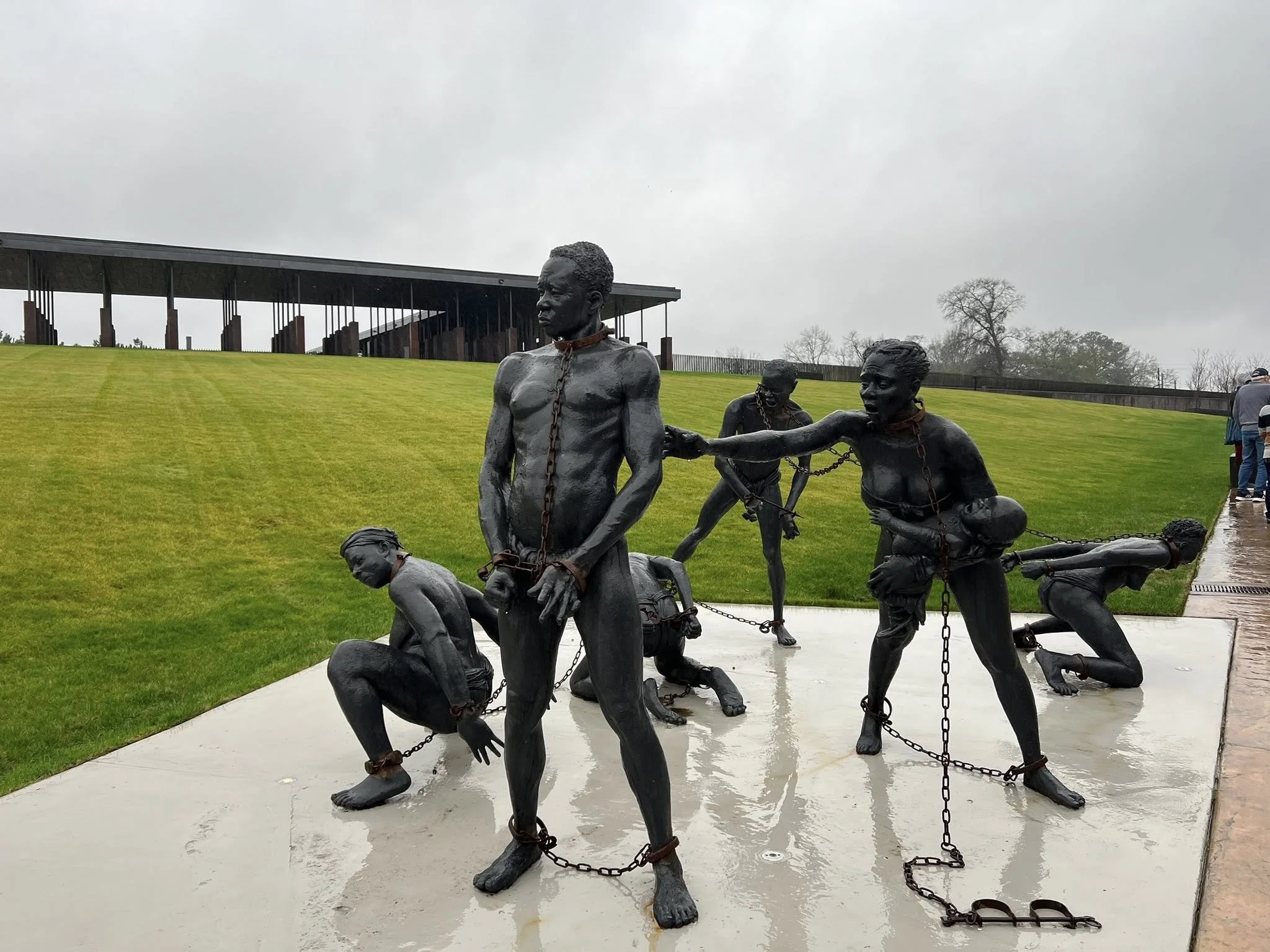
“Do you remember the first time you saw me?” Rev. Washington asked me. “The first night we arrived at the hotel?”
“No, not really,” I admitted.
We were standing in the Freedom Monument Sculpture Park in Montgomery, watched by Nikesha Breeze’s 108 Death Masks, cast in bronze. We were four days into our pilgrimage, two seminaries traveling together. Before this week, Rev. Washington had been just one of two dozen little squares in our preparation Zoom meetings.
Rev. Washington remembered seeing me, though. He remembered because he thought I looked scared. Rev. Washington is a tall, Black man with a deep, booming voice, perfect for preaching. Over the week we’d talked many times about the myriad ways he is reminded to lower his voice, to smile, show friendliness, harmlessness, to modify his presence so that he isn’t seen as a threat.
And the first time he saw me, a moment I barely registered, my reaction to him was an immediate concern, because no matter how harmless Rev. Washington may be, if this little white girl feels afraid, that can cause big problems for him. All these dynamics were running through his mind, meanwhile I’m pretty sure my only thoughts had been about the week’s itinerary and how soon we were going to eat pizza. Two very different realities, lived out in the same space.
“Am I invisible?” he asked. “Do you see me?”
“Grant that I may not so much seek to be consoled as to console, to be understood as to understand, to be loved as to love.” -St. Francis
In January I attended a Civil Rights Pilgrimage through Georgia and Alabama with Wartburg and United Lutheran Seminaries. Before our journey, I prayed for courage and wisdom, but mostly I prayed for discomfort. God does not promise his followers ease or luxury, but transformation. God promises to change us, and change is not comfortable. So I prayed for discomfort and for all the growth and transformation uncomfortable conversations and experiences and truths make possible.
On our first day we attended MLK Day worship at Ebenezer Baptist Church in Atlanta. It was incredible and much of the service can be viewed online. I highly recommend it, particularly the speeches delivered by Bernice King and by 7th grader, Miss Siara White, though the service in its entirely, the flow and rhythm and presence, was a once in a lifetime experience. These Baptists have a stamina we Lutherans do not: the service lasted about 4 hours.
During worship, Rev. A.R. Bernard also spoke. He talked about Jesus returning from the dead with his wounds, noting that Jesus didn’t return whole and perfect, but scarred, because the wounds are proof that God didn’t abandon him in his suffering.
“He identified himself by his scars, because resurrection did not erase the past,” said Rev. Bernard. “He told doubting Thomas, put your finger in it, put your hand through it. He invited him into his past to understand its tie to his future. He invited Thomas into his pain. He invited Thomas into his experience.”
“Do you see me?”
This, I think, was the central question I puzzled over the pilgrimage. Do we see each other? Does white America see Black America? Can white America, at long last, reach out, touch the wounds, believe and be changed?
“Innocence built on amnesia isn’t virtue, it’s denial.” - Rev. A.R. Bernard
Discussing white supremacy amongst white people who grew up in majority white spaces is a bit like explaining water to fish. We have drowned so thoroughly within it, internalized it so unconsciously, that it becomes hard to see. I don’t walk into a room and worry if people are afraid of me. I don’t worry about being labeled suspect when I go shopping, or take a walk in my own neighborhood, and without initiative and curiosity, I never would think about these things. I’d continue to take them for granted, a natural reality. That’s white supremacy working for me. That’s why it’s so important to name this evil. Without a language for the sin, it remains hidden, misunderstood and unexorcised.
Back in November I attended the Rural Plunge. One of the characteristics of rural communities we named was this: conflict avoidance for good reason. In a small town, you need your neighbors, and that means you pick your battles. In some ways, this is beautiful. It means that folks don’t sweat the petty stuff, that forgiveness comes more routinely and easily. But of course, there are problematic implications as well. What issues are addressed? When? How? By whom? Is there ample practice of conflict resolution and truth telling?
I see in my own midwestern, Minnesotan, Scandinavian, Lutheran heritage this same tendency for conflict avoidance. We are a passive aggressive people. That trait in and of itself is not problematic, but when we lose the skills of truth telling, the muscles for hard conversations, we can imprison ourselves in ignorance. White supremacy thrives in silence, in conflict avoidance, in the maintenance of the status quo.
In his book, Just Mercy, lawyer, activist and founder of the Equal Justice Initiative, Bryan Stevenson, traces the four institutions of American history which have shaped our approach to race and justice, four institutions which remain, to this day, poorly understood by the American public, and especially by white America. These are slavery, racial terror and lynching, Jim Crow and segregation, and mass incarceration.
These iterations are symptoms of the same root problem, one which has never been honestly recognized or resolved by the nation, and that is white supremacy. The throughline of American history is white supremacy. And this journey was not the study of Black history as opposed to, or as an optional addition to, American history. Black history did not occur in a vacuum. This pilgrimage was not merely about admiration for Black resilience and resistance: it was an inspection of white hatred and complicity, the systemic maintenance of white control and power which is foundational in this country. They are not two separate and parallel narratives, but aspects of one whole truth. Without this whole history, America lives in denial of its own identity.
That this honest and more complete history is not taught in our schools is yet another tool of power maintenance. There is a continued denial of sins and the rejection of the reality that America owes Black people for the wealth they were forced to create for this, the wealthiest country on earth. Today, this history is being actively erased. There are fear-based campaigns to remove Critical Race Theory from education. During our pilgrimage, we learned that the National Parks Service had been ordered to remove educational exhibits on slavery in Philadelphia. We deny our children the full truth of our history, and in doing so, we stunt their understanding of reality. We perpetuate blind spots. We fail the truth.
This pilgrimage helped me to put the finger on a problem I did not fully understand, gave me a name for the evil alive and powerful in modern American society, including and especially within the Church, and that is white supremacy. White supremacy, and all the mechanisms at work to maintain it: denial, minimization, terror, apathy, dehumanization, silence.
“If we say we have no sin, we deceive ourselves, and the truth is not in us.” 1 John 1:8
Rev. Kenneth Wheeler is a retired, ELCA pastor, a Black man, and the author of one of the books for our pilgrimage, US: The Resurrection of American Terror. Incredibly, Rev. Wheeler join us on this pilgrimage and walked alongside us each day. He writes, “I was led to write this book because I believe white supremacy is not simply one of many problems confronting this nation or the Church. I believe that white supremacy is the central issue confronting this nation and the church. It is the major theological issue facing the white Church in particular.”
He continues, “White evangelicalism may feed poor people, may give them charity, but it stops short of condemning the institutional systems that create poverty. Likewise, white evangelicals may create a kind of euphoric and sentimental community that mimics racial harmony but they are often silent when it comes to addressing the evils of white supremacy and racism.”
Amen.
White people, existing within white supremacy, have become accustomed to an unnatural degree of comfort and privilege, developing an emotional frailty and a skewed perception of what it means to be liberated. This fragility, wielded as a weapon to avoid accountability, denies our capacity for growth. We shy from nuance and discomfort, from realities which challenge our own.
In the Church in particular, God’s gifts like forgiveness are twisted and weaponized by white Christians to avoid accountability. We adopt cheap grace without repentance. We deny our call to discomfort, to change, to agency, responsibility, care, the call to our own humanity. Cries for justice are often perceived as rude, the conversation derailed by tone policing, finger pointing, and what-aboutism. “I grew up poor, I’m not privileged,” is a common response. “We love people of color, look how much money we sent?” is another classic, replacing transformation with transaction. It is, in white America, in white Church, never the right time or tone to address white supremacy.
Rev. Wheeler repeatedly identified the maddening hypocrisy of white silence in the Church which claims to preach forgiveness, redemption, and deep love for all of God’s people. Martin Luther King Jr. spoke truth in his Letter from Birmingham Jail, saying:
“I must confess that over the past few years I have been gravely disappointed with the white moderate. I have almost reached the regrettable conclusion that the Negro’s great stumbling block in his stride toward freedom is not the White Citizen’s Counciler or the Ku Klux Klanner, but the white moderate, who is more devoted to ‘order’ than to justice; who prefers a negative peace which is the absence of tension to a positive peace which is the presence of justice…Shallow understanding from people of good will is more frustrating than absolute misunderstanding from people of ill will. Lukewarm acceptance is much more bewildering than outright rejection.”
Repeatedly in his work and on this journey, Rev. Wheeler cited the white Jesus he heard worshiped in white spaces, a Jesus who did not care for, honor or see his struggle as a Black person in America. It is a narrow, hollowed version of God. There is no liberation in such a safe and small faith.
I am not ashamed of the gospel. And I am not ashamed of the Lutheran theology I was raised in, the values I was taught to embody. But I am ashamed of the ways faith has been packaged for me, a white Christian in America. I am ashamed of the way the Church has been commodified, a Holy country club, a factory of feel-goodery, where the realities of the world are hidden behind high, glittery walls, where realities of human suffering are silenced for the sake of comfort, where truths of discrimination are kept behind caution tape. We are not to step on toes; do not upset the donors. It is diluted faith, a gospel of order, not justice. I am ashamed of the ways I have frequently accepted and internalized this reality without questioning, without even noticing.
When I answered this call to ministry, and my faith took on a more public face, I found myself overexplaining. I was worried about my secular friends and the Christian Nationalist hate they might now associate with me.
“We’re not like those Christians,” I’d say, “We’re Reconciling in Christ. We’ve got a pride flag in the narthex. We feed the hungry and give to the poor. We love our neighbors, seriously.”
And while I still maintain a deep pride in the congregation I was raised in, I fell short of asking why it was that I had to make this distinction in the first place, why there are so many white Christians in America comfortably worshipping a God of hate and division, dehumanization and judgment, violence and silence and death. I did not question deeply why it seems we have two irreconcilable Christian Gods in America.
And I understand now, more than before, that this is not a single issue among many but the root sin and danger within America and within the Church of today. This pilgrimage helped to name our trouble – it is white supremacy.
And I recognize, viscerally, that understanding is not enough. As Bernice King told us at Ebenezer Baptist, this is not merely commemoration: this is commitment. There must be an investment, a discipline to action and ongoing transformation. We have work to do.
“There have been a lot of words,” writes Rev. Wheeler. “We need action. We need white Christians to make their good words mean something. We need white Christians to put flesh on those words.”
“So if anyone is in Christ, there is a new creation: everything old has passed away; see, everything has become new.” 2 Corinthians 5:17
“What have you learned?” Rev. Lynette asked me. We had spent a long and heavy morning in the Legacy Museum and now were making our way slowly up from the boat dock towards the Freedom Monument Sculpture Park in Montgomery.
“When I, with my white body, am in a pulpit looking out at white faces, I am in the exact, necessary place to talk about white supremacy,” I said. “White doors open for me. White ears open for me. White supremacy, this is not Black people’s problem. This is a white people problem.”
Rev. Lynette chuckled without humor. “Yes, but see, we can’t say that.”
I nodded. “What about you? What has this been like for you?”
Rev. Lynette then told me the stories she’d just read at the Legacy Museum, graphic accounts of the torture and lynching of a child, crowds gathering to watch fellow human beings tortured and executed, body parts cut away for souvenirs.
She said, “I did not know the depth of your hate.”
I am thankful to all the travelers who took on the Civil Rights Pilgrimage, but I am particularly thankful for the Black leaders and seminary students. They took on a different risk, a distinct level of trauma, and they came ready for truth telling. Their presence was priceless.
My experience of trauma is this: there is the initial wound, the original harm. We are a fallen humanity: inevitably, people hurt one another. This kind of harm is terrible, but digestible, explainable. We are resilient. We can scab these over. We can overcome. But then there is the reaction to the wound.
When the perpetrator, the neighbor, the community, responds with disbelief, denial, or further injury, the initial wound has no space to heal, and rather, evolves. In a toxic environment, a wound will not close but become infected. It is no longer scabbing but continually reopened. Rev. Dr. Martin Luther King, Jr. said, “In the end, we will not remember the words of our enemies, but the silence of our friends.” Rev. Kenneth Wheeler said, “It is not just the violence which is resurrected, but also the wound.”
White Americans have failed to acknowledge or attend to the wounds of Black Americans, and so they fester. The injury is alive. It has accumulated and evolved into this massive trauma, perhaps best illustrated by the towering Freedom Monument, holding 122,000 surnames of the 4.7 million enslaved. I will never forget standing before this monument, watching my fellow pilgrims, folks who over the week had become new colleagues and friends, these beloved people physically dwarfed by this mountain of horror and grief, searching for the names of their families. I will never forget.
The trauma of white supremacy is not healed by time. Rather, because of the continued maintenance of white supremacy, because of the persistent toxicity of this environment, time only deepens this wound. Each microaggression, each systemic injustice, each racist traffic stop, each glance of suspicion, each fresh alienation, humiliation, each imprisonment, each murder, each knee on the neck – it is not one injury but every injury, resurrecting a society-level wound which cuts deep and across, through generations.
Before the pilgrimage, I knew facts. I had read the history and the art and the stories. I was familiar with Baldwin, Coates, Davis, Du Bois, hooks, Gay. But this pilgrimage brought a new, more visceral perspective, a different kind of knowing. And now I am home and this truth demands something more of me: commitment.
“If you decide to stand in solidarity with the oppressed groups in America,” writes Rev. Kenneth Wheeler, “Remember that the decision will engage you for a lifetime.
“Love does not delight in evil but rejoices in the truth.” 1 Corinthians 13:6
Here is a fact white Christians in America need to wrestle with: It is possible to attend church every Sunday of our life, to say grace before each meal and wear a cross upon our chest, to perform Christianity, and still grow no closer to becoming the people God calls us to be. It is possible to live a visually Christian life while keeping our hearts hard and unmoved by the human suffering around us.
I see in America a mask of Christianity which goes no deeper than the surface, a performance designed for comfort, not justice. This is not the faith of all white Christians in America, but all white Christians in America must contend themselves with the problem of white supremacy and Christian Nationalism. Our theology demands we find the language to speak to this evil and exorcise it. We cannot remain silence when God’s name is used so hatefully.
We are not called to love our religion but to love our neighbors. This is Jesus’ clearest call for our lives, and the white Church in America has failed to answer. For too long we have maintained the illusion of separation, that our fates are not entwined. We have permitted silence where there must be words, and when we have spoken, we have stopped at words which never take on flesh, never take action, or actions which appear only briefly, then fizzle and fade. We must imagine better. We saw in the Legacy Museum this struggle spanning generations, which means we must not grow weary or hopeless. We were handed this moment to continue a march which began before us and will, God willing, continue after us.
Injustice inflicted upon our neighbors is injustice upon us. Furthermore, the one who inflicts brutality has dehumanized themselves. This is not about liberation of people of color to the elevated status of white people, but the restoration of humanity to all people. As Rev. Wheeler reiterated several times on this journey, “Jesus came to liberate all oppressed people from oppression, I therefore believe that Jesus came to liberate white people from the enslavement of white supremacy.”
On the first day of our pilgrimage, after MLK Day worship at Ebenezer Baptist Church in Atlanta, we gathered to read aloud the Six Principles of Nonviolence engraved at the Martin Luther King Jr. National Park. Principle three is this: “Nonviolence seeks to defeat injustice, not people. Nonviolence recognizes that evildoers are also victims and are not evil people. The nonviolent resister seeks to defeat evil, not people.” Defeating white supremacy is not about beating white people, but liberating them. As Rev. Lynette said in our final gathering, “Hit them over the head with love.”
At worship we confess we are in bondage to sin and cannot free ourselves. I wonder what would happen if white Christians, particularly in our majority white congregations, began to name those sins as we know them, if we confessed together that we are in bondage to white supremacy and cannot free ourselves. That we are entrenched in systems of inhumanity and need a new way of being in the world, that we need God’s imagination and vision and wisdom to take us there.
White Christians in America can not afford to deceive ourselves any longer. We must name the evil of white supremacy, welcome the truth with all the discomfort it may bring, and allow the truth to set us free.
“The America of my experience has worshiped and nourished violence for as long as I have been on earth. The violence was being perpetrated mainly against Black men, and so it did not count. But, if a society permits one portion of its citizenry to be menaced and destroyed, then, very soon, no one in that society is safe.” -James Baldwin
People are comparing what is happening in Minneapolis and Minnesota today with Nazi Germany, but it is more accurate to say this is merely a continuation of the same trouble we have always had. The Nazi party studied and was inspired by American white supremacists, their treatment of indigenous and Black people. American slavery, Jim Crow, mass incarceration, and now the terrorizing of immigrants and people of color are all manifestations of the same root of evil, and that is white supremacy.
I was on the flight home from our pilgrimage when I saw the man in the row ahead of me watching Fox News and that is how I learned Alex Pretti had been murdered. This time, I had a fresh, clarified language for what I was seeing.
Like the martyred white Civil Rights activists across American history, Renee Good and Alex Pretti were killed by the state because they betrayed their whiteness, because they stood in the way of the systems of control and hatred which defend the lie that white bodies are more valuable than others. These are not separate issues. White supremacy creates a narrative of hierarchy, and all intersectional identities are told to fall in line.
We have allowed citizens and innocents to be menaced. We have permitted evil to thrive in our midst. This terror is the consequence. There has always been terror in America; now it is being exacted quite publicly on white bodies, bodies which don’t fit the racist narrative we are comfortable with. Is white America ready, at long last, to really have this conversation? Are we ready, as Rev. Wheeler asks, to “come straight, come real, and come genuine.”
On the wall of the reflection room in the Legacy Museum is the inscription: “We stand on the shoulders of those who did so much more with so much less. We resolve to honor their legacy and continue their struggle.” We have this incredible history of resistance; it must not just be contained and admired and separated as Black history, contained in an honorary month and collecting dust the rest of the year. No, this incredible history is to be understood, honored and embodied today as the history of all Americans. Just as Christ’s blood is for all people, the blood shed on the Edmund Pettus bridge was for all Americans. The struggle for liberation is fought for us all, whether we recognize it or not. We are all enslaved to this lie of white supremacy and we are all going to be liberated from it.
“Revelation, then redemption: is there anything more American?” -Jon Meacham
“I return to the Zulu greeting sawubona, which literally means I see you.” writes Rev. Wheeler. “I wrote this book knowing that we have not seen each other as Black and white people in this nation and also knowing that this seeing is achievable if we have courage enough to tear down this wall that has divided us for centuries.”
If white America, if the white Church in America, finally decides to truly see Black America, if our eyes are opened, we will be changed. Love will transform us. So we must approach the truth. We must seek understanding. We must learn our shared history. The history of Black struggle and suffering is equally the history of white violence, oppression, neglect and hatred. Without fully understanding our history, we cannot grasp where it is we stand today and we cannot hope to move forward to a new shared future.
The work is simultaneously overwhelming and simple. We need to see one another. We must be active in repair. We need to see with our hearts. We need to be stirred beyond sorrow or guilt into action and love. White Christians, we need to reach and touch the wound.
“Do not conform to the pattern of this world, but be transformed by the renewing of your mind.” Romans 12:2
In her book, Wintering, Katherine May writes about the costly songs of the early robins. They sing early, even when they are not yet singing for mates or territory. Fruitlessly burning calories, they sing these costly songs, just to be heard, just to raise their voices.
“Like the robin, we sometimes sing to show how strong we are, and we sometimes sing in hope of better times,” writes May.
The last night of our pilgrimage, Rev. Kenneth Wheeler led us in singing Ain’t Gonna Let Nobody Turn Me ‘Round. Two seminaries stood together in the hotel lobby and sang. “Singing is a form of resistance,” he said. Less than a week later, I would be singing that very song in the sanctuary of my church as the community gathered for an evening of resistance singing. Lately, I am singing every day.
There is a large cost to liberation on earth. The truth is expensive. The price of nonviolence is often blood. There are these costly songs for us to sing. But we will keep singing.
Rev. Lynette said, “Even when we are pushed back, we are facing forward.”
Bryan Stevenson wrote, “You’ve got to beat the drum for justice.”
And Jesus said, “Blessed are those who are persecuted for righteousness’ sake: for theirs is the kingdom of heaven.”
So we keep moving forward towards the Beloved Community.